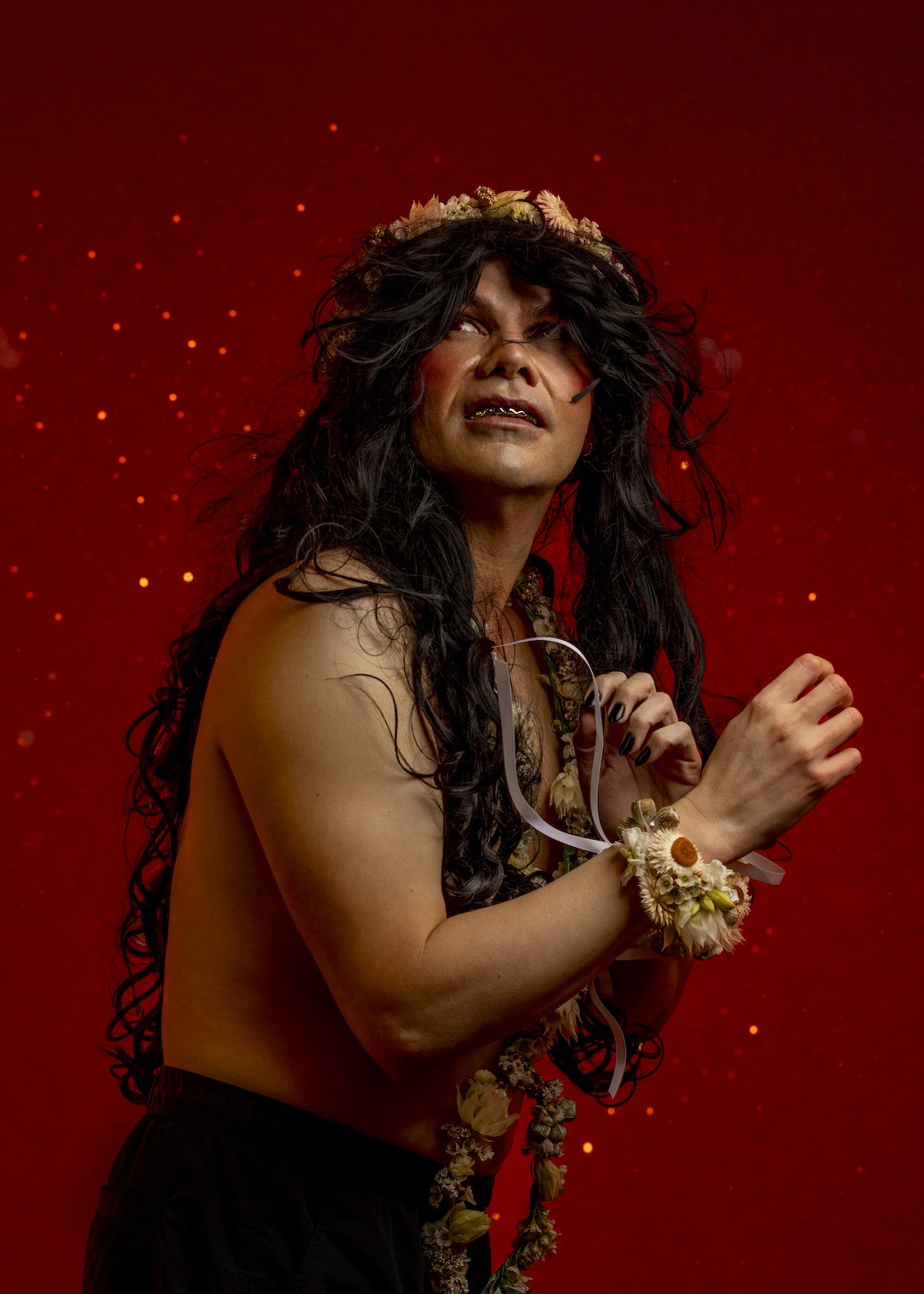
Ember, 2025
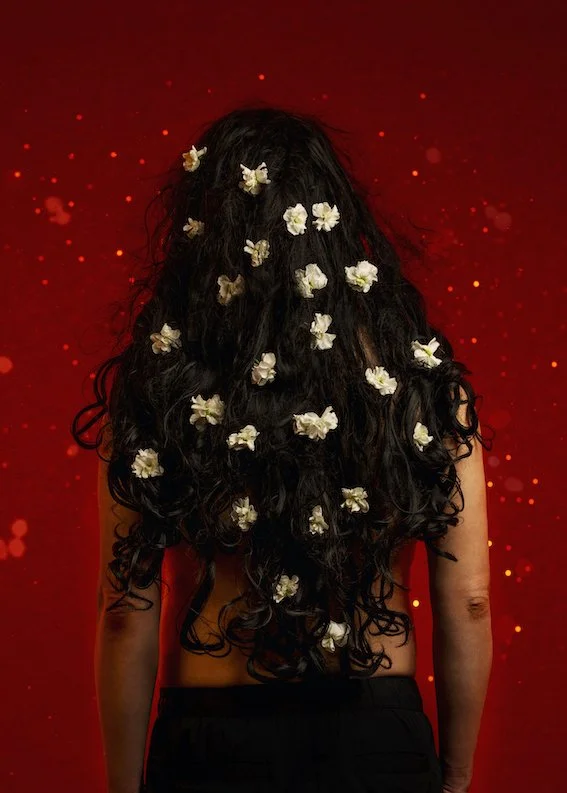
Christian Thompson AO, Ember I, 2025, C-type print on metallic paper, 120 x 85.73 cm, edition of 3 +2 AP
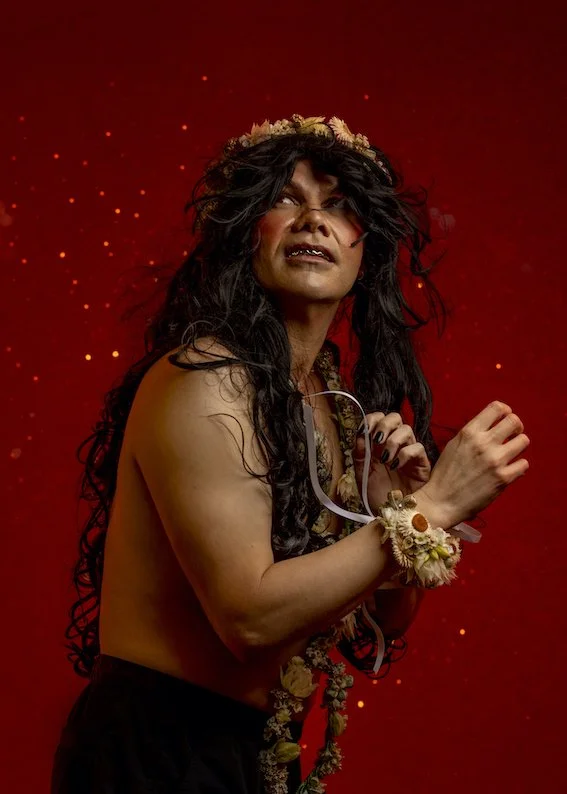
Christian Thompson AO, Ember II, 2025, C-type print on metallic paper, 120 x 85.73 cm, edition of 3 +2 AP
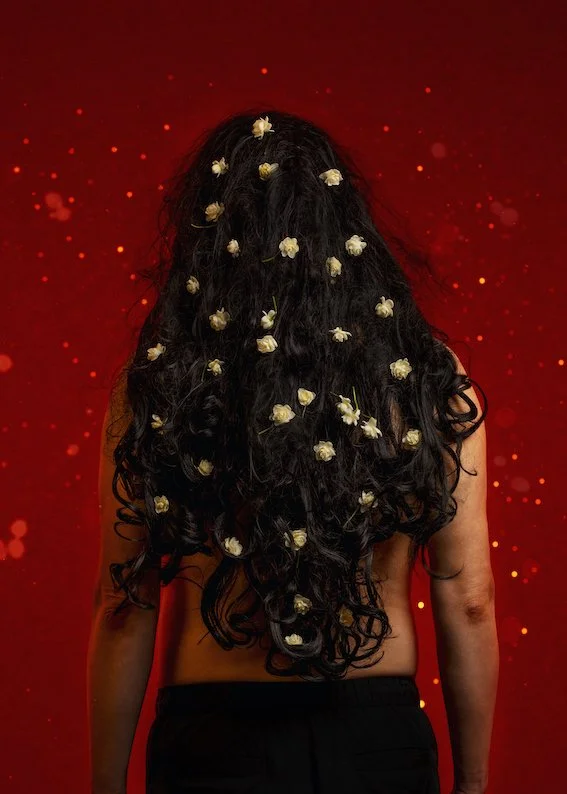
Christian Thompson AO, Ember III, 2025, C-type print on metallic paper, 120 x 85.73 cm, edition of 3 +2 AP
AN EKPHRASTIC
ESSAY
EMBER (IMAGINED ARTWORK)
AN EKPHRASTIC ESSAY: EMBER
The central figure in Ember is not just a figure; it is a coil of paradox. It is a form that wraps upon itself, a posture that exudes both protection and provocation. The body folds like smoke, like a serpent resting after a strike. However, the tension is palpable. In this suspended moment, the figure throws its head back, red eyes gazing to the heavens, a cascade of long black hair unfurling into the crimson void, strands caught mid-motion as if stirred by an internal wind. The hair is adorned with tiny white native flowers — ghostly and delicate — like a garden blooming where it should not survive (Fig. 01).
The background is blood-deep and borderless: an endless red field layered with burnished tones that breathe and flicker like the dying coals. There is no horizon. The figure does not stand against this space but within it, not separate from the fire but forged by it. The skin is bronzed red, smooth, and gleaming like hammered metal, a surface shaped by heat and history. Around the neck lies a floral necklace, delicate and organic, echoing white flowers threaded through the hair. The petals are edged with gold, as if kissed by flames, their softness tempered by a shimmer that hints at resilience. Small matching floral wristbands circle each wrist — garlands, almost ceremonial — also lightly sprayed with gold, their gentle opulence contrasting with the figure’s coiled posture and fierce expression. Light finds it and clings to the ridges of bone, to the curling fingers tipped with sharp black nails that glint like obsidian blades.
It is the mouth that demands attention. The figure’s lips are parted in something between a grimace and a grin — a moment before laughter or a growl. Inside, a shimmer: gold teeth, dazzling, sharp, and extravagant. The grin is not just a grin; it is a defiance, a celebration of survival. It mocks pain and reveres survival in equal measure. It says, “I endured — and I emerge.”
There is no mistaking this: Ember is not passive. It burns. The golden highlights across the body are not ornamental; they rise from within — scars turned sacred, defiance turned divine. The white flowers in the hair speak of memories, of softness grown from fire. They do not wilt. They bloom beside ash.
Either side of the central panel holds portraits that are turned away. These flanking figures, framed from behind, echo the central form’s stillness and strength (Fig. 02 and 03). Their long black hair falls in an eerie fashion, almost. The strands fall with such deliberateness that they appear sculpted, frozen in time. Each is decorated with small white flowers as the central figure — a quiet continuity, a visual whisper of shared memory. There are no visible faces, only the slope of shoulders and the fall of hair, leaving the viewer to wonder whether these figures are past selves, guardians, or witnesses.
Is this a person or an ancestral spirit figure that defies categorisation and revels in it? This figure is not intended to be deciphered. It is meant to be felt — in the stomach, in the teeth, in the flesh. It is neither a man nor a woman, neither a warrior nor a victim. It is power-coiled. It is grief made gold. It is the smouldering quiet after history’s blaze. It is power, raw and unyielding, a defiance of social norms and a celebration of identity.
Ember captures a truth that cannot be spoken, only survived through. The photograph does not demand attention. It commands it. Moreover, in its glow, the viewer feels themselves unravel — coiled in memory, lit by something old, something glowing, something new.
The power of Ember lies not only in its form but also in its palette — a carefully orchestrated symphony of red, gold, white, and black that vibrates with emotional and symbolic weight. The red is not just background, not just blood or fire; it is atmosphere, intention, memory. In Chinese culture, red carries profound significance, symbolising power, abundance, celebration, and life itself. It is the colour of good fortune and prosperity, worn at weddings, the colour of double happiness offering envelopes for marital bliss, painted on doorways, and carried in lanterns to ward off evil. In this context, the red of Ember may not only signal inner heat or emotional weight but also ancestral wealth and spiritual vitality. It evokes the ceremonial, eternal, and sacred. When viewed through this cultural lens, the images take on an additional layer: the figure is not only burning but also blessed. It consumes the frame without overwhelming it, layered in varying intensities, from deep maroon to glowing crimson. Red becomes an emotional landscape — anger, passion, heritage, danger, rebirth — shifting in meaning as the viewer shifts in stance. It surrounds the figure but also seems to breathe through it, as though the figure has absorbed the very heat of its surroundings and becomes an ember itself (Fig. 01, 02 and 03).
Gold operates differently — not dominantly, but piercingly. It appears where light meets history: in the teeth, wristbands, and outlines of petals. It is the colour of treasure and triumph, of something valuable surviving destruction. Gold in Ember is not wealth; it is resilience and adornment made holy. It feels applied not for beauty’s sake but as a ritual, as an offering, as an inheritance. It is sacred burnish — a marking, a crowning, a consequence.
In its limited but potent presence, white becomes the most haunting. The small white flowers in the hair and on the body are symbols of fragility and mourning, but they also symbolise persistence. They are not bleached or sterile — they glow faintly, carrying the suggestion of spirits, of memory, of things that return. White does not purify; it punctuates. It breaks the red with softness, grief, and a touch of grace.
Finally, the black — found in the cascading hair and razored nails — is the work’s anchor. It grounds the palette in the shadow and sharpness. The impossibly dark hair becomes a void of its own. A portal. A shroud. Black nails are weapons, yes, but also declarations. They point, claw, and remind.
Taken together, these four colours create a graphic of immense power — not a simple harmony but a kind of chromatic tension that energises the whole triptych. Each colour plays off the other, just as each panel refracts the mythos of the central figure. The palette is as much a part of the narrative as the figure itself: the red of trauma, the gold of survival, the white of memory, and the black of depth. In this way, Ember does not merely show a body. It shows us cosmology.
The fashion and adornment of the central figure heighten this sacred, visual language. The gold-encrusted teeth glint with ritual extravagance, while the carefully arranged flowers — in the hair, around the wrists, across the collarbone — speak of ceremonial care. These are not random accessories; they are declarations of intent. They suggest preparation, reverence, and the embodiment of cultural memory. In Indigenous traditions worldwide, decoration has long been a form of storytelling — from the ochre that maps Country onto skin, to possum-skin cloaks inscribed with kinship, to feathered headdresses worn in dance. In Ember, adornment becomes the language through which the body speaks of its survival — not quietly, but with glittering, visceral clarity.
This act of self-decoration — lush, precise, unapologetically excessive — aligns Ember with the theme of affective passage in toxic times. This highlights how fashion and joy become tools of resistance. In a world scorched by violence, invisibility, and dispossession, the deliberate crafting of beauty is an act of survival. Ornamentation signifies defiance; joy signifies protest. The figure’s dance-like posture, the feline alertness of its eyes, the gold teeth, and the black nails — all signal a life lived fully, fiercely, and with intent.
The sharing of embodied stories — of fashion, of land, of memory — is how Ember builds meaning. This work is born of interconnection, drawing from ancestral knowledge, cultural inheritance, and ceremonial imagination. Every gold fleck and bloom is part of a relational network that resists individualism and embraces the collective.
In Ember, ornamentation is not excess but essence. Opulence is not a mask but a mirror, reflecting the rich, complex entanglements of culture, history, survival, and celebration. The decorative does not distract; it concentrates meaning instead. Each golden gleam and floral gesture becomes a site of resistance, a reclamation of space in which the sacred and stylish coexist without contradiction. This is joy as freedom. This is beauty as a battle cry.
The emotional force of Ember lies in its refusal to be fully understood. It denies the viewer a straightforward narrative or fixed identity. Instead, it offers sensations, presence, and power. It asks not to be read but felt. Ember disturbs in precisely this way — it unsettles, resists taxonomy, and insists on being felt rather than understood. In doing so, it invites an affective encounter in which the viewer is not merely an observer but a participant. You do not watch Ember. You pass through it. You are scorched, ornamented, and transformed.
This photographic triptych is more than an artwork — it is an altar. A constellation of memory, movement, and meaning forged in the crucible of toxic times. And yet it glows. Fiercely. Elegantly. Unapologetically.
-
Originally published in Fashion Highlight No. 5, 2025, “Affective Passage in Toxic Times: Fashion and Joy as Resistance,” Firenze University Press, Florence, Italy.