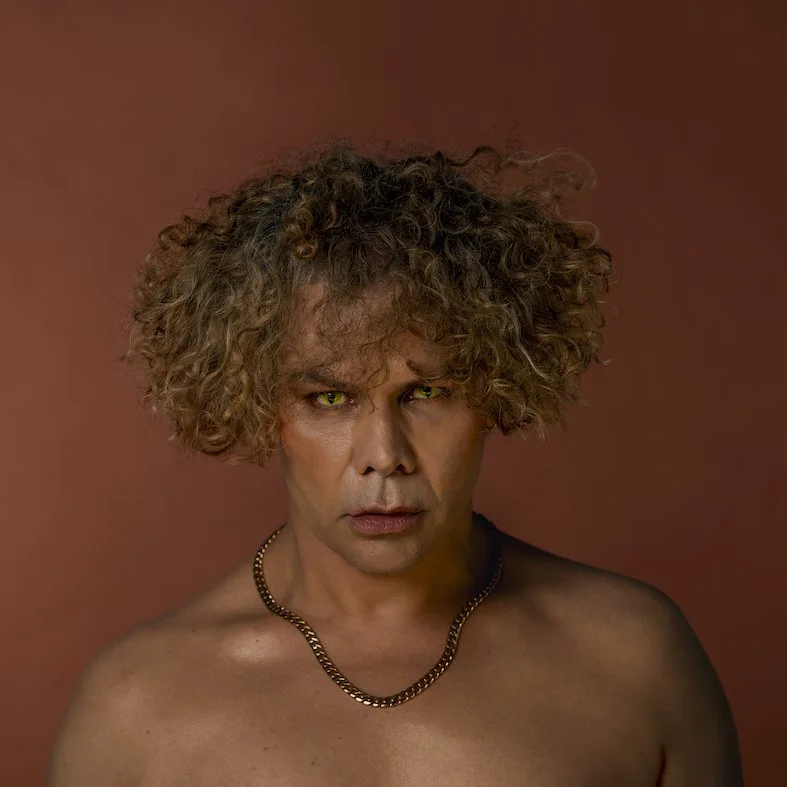
Body is Country, 2025
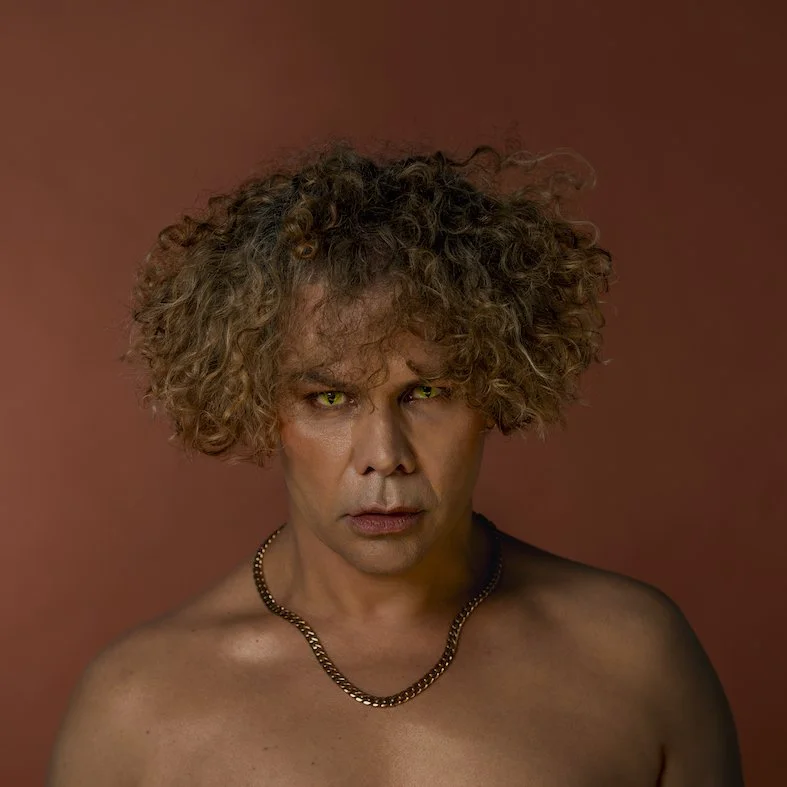
Christian Thompson AO, Body is Country 2025, C-type print on metallic paper, 120 x 120 cm, edition of 3 +2 AP

Body Is Country -
Dr Christian Thompson AO
This essay explores a contemporary portrait of a solitary Bidjara figure suspended within a dense field of mineral ochre. The figure’s burnished copper curls, bronzed skin, and arresting gaze—rendered uncanny through luminous reptilian contact lenses—confront and subvert dominant colonial and Western visual regimes. Through the visual language of fashion and editorial photography, the work embodies an act of Indigenous self-fashioning that entwines cultural identity, spiritual connection, and political resistance. Drawing on concepts of Country as both land and lived embodiment, the essay explores how the figure’s body emerges as a site of ancestral memory, ceremonial practice, and ongoing assertion against the enduring shadows of colonialism and racism.
Beyond their deep connection to Bidjara Country and ancestral memory, the figure carries the weight and wisdom of immense life experience—an embodiment not only of place but of global presence. Their stillness reflects movement across physical and cultural landscapes, transcending borders while remaining anchored in Indigenous sovereignty. This global dimension challenges reductive narratives that confine Aboriginal identity to static notions of tradition or isolation. Instead, the figure asserts a contemporary Indigenous subjectivity that navigates complex histories, diasporas, and intercultural exchanges while maintaining an unbreakable bond to Country. The portrait honours Indigenous peoples as cosmopolitan, resilient, and world-wise, moving through a settler-colonial present while carrying the knowledge of ancestral legacies.
Hair as Archive
The figure’s untamed copper-gold curls spread outward with electrical intensity, partially obscuring the face while framing eyes that glow with reptilian luminosity. Hair, here, is not merely stylistic; it is a locus of memory and ritual. For us as Bidjara people, hair carries deep cultural and spiritual significance, functioning as a conduit between body, memory, ancestry, and Country. It holds energy. It remembers.
The figure’s tightly coiled curls carry the distinct texture and density long associated with many Aboriginal peoples of the Central Desert—an inherited marker of embodied identity that has historically rendered the Aboriginal body both hypervisible and vulnerable within colonial regimes of racial perception.
These curls speak of ancestral lineages and resistances tangled with centuries of survival. Their visibility resists colonial attempts to erase or contain Indigenous subjectivity. Hair becomes ceremonial in and of itself—a magical praxis of becoming. Its looseness and refusal to conform reflect a broader refusal: to yield to settler expectations, to comply with Western binaries, or to be anything other than sovereign.
In this context, fashion becomes spell work. A curl becomes a song line. Styling becomes ceremony.
As Shawn Wilson reminds us, ceremony is not separate from Indigenous knowledge production, but integral to relational ways of being and understanding. Within this framework, the portrait itself becomes ceremonial encounter rather than static representation.
Hair is also a signifier of an ongoing relationship to Country. It grows from the body just as trees grow from the soil—fed by the minerals of the earth, informed by ancestry, carrying the scent of place. Hair is not an accessory but a living extension of the land itself. The figure’s luminous curls emerge from this cosmology. They declare belonging not as aspiration, but as inheritance. Where settler attempts to belong produce hallucinations—of innocence, of nativity—the Bidjara body knows otherwise.
Skin as Country
The figure’s bronzed skin glows with a golden-red hue evocative of ochre, ember, and the scorched mineral tones of the Queensland Central Desert—the ancestral homeland of the Bidjara people. The figure does not stand before colour but emerges from within it. Skin, backdrop, hair, and atmosphere collapse into a single chromatic field where body and Country become inseparable.
This chromatic echo is not incidental; it invokes Country through the visual language of skin. The body becomes a corporeal terrain where land and identity coalesce. Skin is not simply surface; it is geography, memory, and archive.
The portrait’s chromatic intensity recalls Josef Albers’ understanding of colour as relational and unstable—transformed through proximity, contrast, and perception. Yet within Indigenous visual frameworks, colour exceeds formal aesthetics alone, operating instead as relational force—carrying memory, ancestral presence, and cultural continuity.
To speak of skin is also to speak of violence—the violence done to Aboriginal bodies, and the ways skin colour has historically marked Indigenous people for exclusion, surveillance, fetishisation, and erasure. Yet in this portrait the skin is luminous, assertive, radiant with its own authority. It refuses to be read solely through victimhood. It glows with pride, inheritance, and knowledge.
This is not skin gazed upon by colonisers with desire or disdain; it is skin as declaration:
I am of this land.
I am the land.
To be culturally coded as Indigenous is to carry a burden that is both visible and unseen. One’s body becomes a battleground of projections, assumptions, and power relations. This coding is not symbolic—it is systemic, lived, and often dangerous. It shapes how one is policed, employed, represented, and mourned.
The figure in this portrait does not shy away from this reality; instead, they wear it as mantle and mirror, reflecting back the violence of the gaze while asserting the truth of presence. Their visibility challenges structures that would prefer silence, invisibility, or assimilation.
Fashion as Resistance
The image consciously employs techniques associated with fashion and editorial photography—dramatic lighting, close framing, stylised composition— to draw the viewer into a mise-en-scène of theatrical intensity. Yet unlike commercial fashion’s frequent appropriation of Indigenous motifs, this portrait reclaims the language of style and spectacle as Indigenous grammar.
Fashion here is not decoration but defiance.
In this sense, the work aligns with Yuniya Kawamura’s understanding of fashion as a system of meaning-making rather than mere adornment, while also resonating with Judith Beyer’s theorisation of anti-gender fashion and the destabilisation of normative visual codes.
The gold chain resting against the bare chest introduces another tension between adornment and exposure, glamour and vulnerability. The portrait destabilises fixed readings of Indigenous masculinity without abandoning strength or authority. The figure is neither hypermasculine nor feminised; instead, they occupy a sovereign visual ambiguity that exceeds colonial frameworks of gendered legibility.
The image moves through the visual language of the avant-garde, the editorial, and the mythic, grounding these aesthetics in cultural specificity.
The luminous contact lenses function as a deliberate rupture of the ethnographic gaze, interrupting colonial expectations of authenticity, legibility, and racial fixity. Instead, the figure becomes uncanny, unknowable, sovereign.
The black void so common to editorial portraiture is replaced by a dense field of heat and mineral colour, suggesting not emptiness but immersion within Country itself. The aesthetic is simultaneously stark and ceremonial. In reclaiming editorial visuality, fashion becomes a vessel for storytelling and refusal.
Concealment and Revelation
The figure’s curls partially obscure the face, creating tension between concealment and revelation. This tension mirrors the colonial desire to know, catalogue, and possess Indigenous people, and the enduring resistance to such acts. Hair is not neutral in this context. It carries the residue of ceremony, intergenerational teaching, and stories whispered during acts of care and grooming.
Within settler-colonial cultures, hair has often been cut, hidden, or styled to render Indigenous people more acceptable, more “civilised.” To wear hair wild and unconfined is therefore an act of reclamation.
It says:
We are not here for your comfort.
Despite this powerful assertion of identity and agency, the image also gestures toward the ongoing realities of colonial violence. Contemporary racism— structural, intimate, institutional—remains an extension of colonial logic. It persists in the misrecognition of Aboriginal people, in the gatekeeping of legitimacy, and in the exploitation of Indigenous imagery for commercial or academic capital.
The figure in this portrait does not seek approval or assimilation. Instead, they return the gaze unflinching, spectral, sovereign.
Reckoning
This image does not ask for reconciliation; it demands reckoning. It exposes the enduring structures that position Aboriginal identity as a resource to be mined, a brand to be worn, a story to be borrowed.
In doing so, it critiques the Western hunger to claim Aboriginality without confronting complicity. The portrait asks what it means to belong to this land truly, and answers with embodied certainty:
You cannot know unless the land knows you.
The figure is not symbolic—they are specific, embodied, and real.
This portrait of a solitary Bidjara figure is a meditation on the inseparability of body, Country, and memory. Through aesthetic precision and visual audacity, it asserts a mode of being that is simultaneously ancient and contemporary. The figure is not merely depicted; they are conjured into presence, resisting the flattening logics of colonial time.
The body is Country.
Hair is archive.
Skin is earth.
Eyes are ceremony.
Fashion is resistance.
Together these elements form a living map of Bidjara identity, global experience, and unbroken connection to land and law. In a world still haunted by colonial violence, the portrait becomes both return and refusal.
We are still here. We always have been. And we are not yours to define.
End Note
Body Is Country was presented as a keynote paper at QATACON: The Stories We Tell, Brisbane, 2026.